I got the same question twice in one week. Both times, same shape: “Is thymosin alpha-1 the same as thymulin?” Both times, I said no, then had to explain why the two names keep getting filed in the same drawer.
Here’s the short version before I show my work. They share an address. That’s it. Everything past the address is different, and one of them has a paper trail. The other one has a theory.
The address they share
Both peptides come out of the thymus, the small gland behind your breastbone that runs quality control on your immune cells. Raw material goes in, trained T cells come out, and the thymus does that job by handing out signaling peptides along the way. Thymosin alpha-1 and thymulin are two names on that same payroll.
That’s where the resemblance stops. Same gland doesn’t mean same molecule, same job, or same amount of proof behind it. I went looking for what each one actually has on file. One of them checked out. The other one, not so much, not yet.
Suspect one: thymosin alpha-1, the one with a rap sheet
This is the heavyweight, and it isn’t close. Thymosin alpha-1 is a 28-amino-acid peptide. Its synthetic twin, thymalfasin, sells under the name Zadaxin, and it’s an actual approved drug, not a rumor. A 2020 review puts it as approved in more than 35 countries, mostly for chronic viral hepatitis and as a helper drug in cancer care, working by activating dendritic cells, pushing T cells toward maturity, and switching on natural killer cells [1] (World Journal of Virology, 2020).
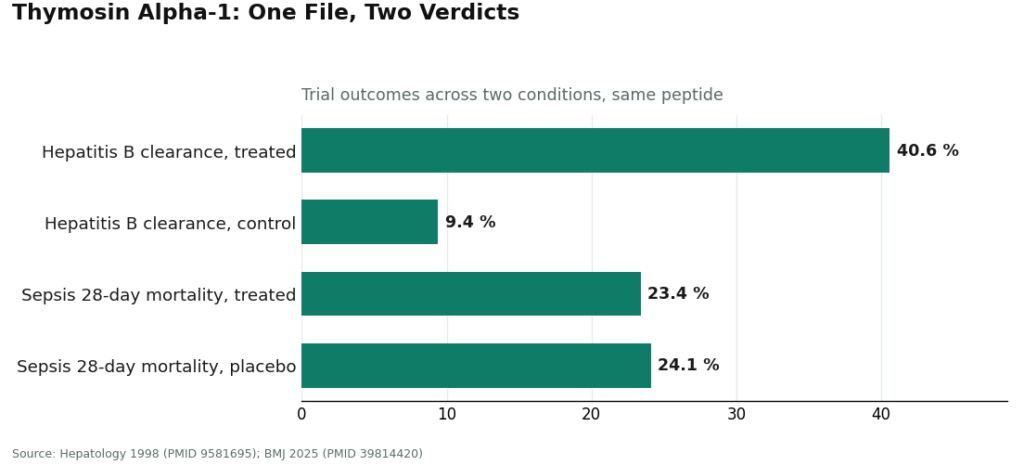
A rap sheet cuts both ways, and that’s what makes it worth trusting. For chronic hepatitis B, the file is strong. A 1998 randomized controlled trial found a 26-week course cleared the virus in 40.6% of patients, against 9.4% in the untreated group, a real, statistically significant gap [2] (Hepatology, 1998).
But I don’t cherry-pick a case file, and neither should you. The biggest, best-built trial ever run on this peptide, a 2025 placebo-controlled phase 3 study in the BMJ covering 1,089 sepsis patients, came back empty. 28-day mortality: 23.4% on the drug, 24.1% on placebo. No real difference [3] (BMJ, 2025).
That’s the tell, actually. A win in hepatitis B and a clean loss in sepsis, both on the record, both public. That’s what an honest file looks like. Nobody polished this one.
Suspect two: thymulin, the one running on a theory
Thymulin’s a different animal. Smaller, for one, a nine-amino-acid peptide made by the thymus’s epithelial cells. And it’s got a quirk that reads like a detail out of a lab notebook: it doesn’t do anything without zinc riding shotgun. The research describes thymulin’s biological activity as dependent on zinc binding to it in a one-to-one ratio. The zinc-bound version is the active version. Serum thymulin activity drops when someone runs zinc-deficient, and it comes back when zinc is restored [4] (Medical Oncology and Tumor Pharmacotherapy, 1989). Same source credits it with driving T-cell differentiation and general T-cell function (Medical Oncology and Tumor Pharmacotherapy, 1989).
That’s a real piece of biology. I’m not knocking it. A hormone with a mineral for an ignition key is genuinely interesting.
But interesting isn’t the same as proven, and I’m not going to blur that line for you. Thymosin alpha-1 has decades of trials and an approved drug on the books. Thymulin has a compelling mechanism and a much thinner human-trial record standing behind it. When it’s sold online, it’s sold on the strength of that mechanism, because the hepatitis-B-grade trial file doesn’t exist for it. The zinc story checks out. The outcomes file, the kind of thing juries want, mostly doesn’t exist yet.
Side by side, no spin
Size and build. Thymosin alpha-1 runs 28 amino acids (World Journal of Virology, 2020). Thymulin runs nine, and needs zinc attached to work at all (Medical Oncology and Tumor Pharmacotherapy, 1989). Different weight class.
How they move. Both work the T-cell system, different routes. Thymosin alpha-1 goes through dendritic cells, T-cell maturation, natural killer activation (World Journal of Virology, 2020). Thymulin drives T-cell differentiation, zinc-dependent the whole way (Medical Oncology and Tumor Pharmacotherapy, 1989). Same neighborhood, different streets, like I said.
The evidence, which is the whole case. Thymosin alpha-1 has been through real human trials, a genuine win in hepatitis B, an honest loss in sepsis. Thymulin’s evidence leans on mechanism, not on a stack of large randomized outcome trials. If evidence is the thing you’re weighing, this is the gap that decides it.
Paperwork with the government. Thymosin alpha-1 is an approved drug outside the US, reachable here through compounding. Thymulin doesn’t carry that same approved status. Neither one is FDA-approved stateside. Nobody walks free on this one.
Who this actually fits
I don’t do wishy-washy, so here’s my read.
If you want a peptide with a real trial history, one you can pull up and read the results of yourself, thymosin alpha-1 is the one with the file. That doesn’t mean it’s a fix for whatever you’ve got in mind, it flunked the sepsis trial, remember. It means that in the one lane it’s genuinely proven, chronic hepatitis B, there’s real data, and everywhere else you at least get honest results instead of silence.
If thymulin’s the one pulling at you, go in knowing what you’re choosing. The zinc mechanism is real and it’s a good story. But “good story” and “proven in people” sit in different tiers, and thymulin’s still mostly in the first one. That’s a legitimate choice, as long as you’re making it with eyes open and not assuming the two peptides are running neck and neck on evidence. They’re not.
And for a lot of people asking “which one,” the honest answer is neither, not without a professional in the room first, because “general immune support” is a vague target that neither peptide has actually hit in a healthy person. That’s not me ducking the question. That’s the straight answer.
The one thing that holds for both
Whichever name you’re chasing, one rule doesn’t bend. Both peptides push on the immune system, and anything that pushes on the immune system deserves a second set of eyes, especially for people who are immunosuppressed, like transplant patients on drugs holding their immune system down. That’s the kind of red flag a clinician catches on sight and a checkout page never will.
Neither peptide is FDA-approved in the US. The legitimate path for thymosin alpha-1 runs through a licensed compounding pharmacy and a prescription, full stop. A supervised route such as the licensed telehealth provider FormBlends (named here once, as an example of the supervised lane, not a ranked pick) puts an actual clinician and a licensed pharmacy into a decision that otherwise has neither. That matters more, not less, when you’re weighing two different immune peptides against each other.
Case closed, for now
Thymosin alpha-1 and thymulin share a birthplace and not much else. Thymosin alpha-1 is the bigger peptide with the real drug file, a strong win in hepatitis B, a clean loss in sepsis. Thymulin is smaller, zinc-dependent, and running on a good mechanism with a thin trial record behind it. Want proof? Thymosin alpha-1’s the one that’s actually been tested. Drawn to thymulin anyway? Fine, just know you’re picking mechanism over outcomes. Either way, get a professional to look at the file before you sign anything. That part of the case never changes.
A few common questions
Are thymosin alpha-1 and thymulin the same thing? No. Two different molecules that happen to share a birthplace, which is exactly why people mix them up. Thymosin alpha-1 is a 28-amino-acid peptide with an approved synthetic version, thymalfasin [1]. Thymulin is a separate nine-amino-acid peptide that needs bound zinc to function [4]. Same gland, different builds, different mechanisms, wildly different amounts of proof.
Which one has more clinical evidence in humans? Thymosin alpha-1, not a close call. It’s been through large human trials, a real win in chronic hepatitis B [2], a real loss in a major sepsis trial [3]. Thymulin’s case leans on its zinc-dependent mechanism [4] far more than on a comparable stack of large randomized outcome trials.
Does thymulin actually need zinc to work? Yes. Its biological activity depends on a zinc atom bound to it in a one-to-one ratio, and serum thymulin activity falls off in zinc deficiency and climbs back when zinc is restored [4]. The zinc-bound form is the working form. That’s one of the genuinely interesting facts in this whole file.
Is either peptide FDA-approved in the United States? Neither is. Thymosin alpha-1 is approved as a medicine in more than 35 countries as thymalfasin [1], but in the US the legitimate path runs through a licensed compounding pharmacy with a prescription. Thymulin doesn’t carry that kind of approved status anywhere comparable.
Does thymosin alpha-1 work for sepsis or general immune support? The best evidence says no on sepsis. A 2025 phase 3 placebo-controlled trial of 1,089 patients found no drop in 28-day mortality, 23.4% versus 24.1% on placebo [3]. Its one solidly proven use is chronic hepatitis B [2]. General immune support, in an otherwise healthy person, isn’t well-backed for either peptide.
Why would someone pick thymulin if the evidence is thinner? Usually the zinc-dependent mechanism is the draw, not a proven clinical result [4]. That’s a fair choice, as long as the person understands they’re picking an interesting mechanism over the kind of trial record thymosin alpha-1 has in hepatitis B [2]. Either way, loop in a clinician, especially if you’re immunosuppressed.
What is thymosin alpha-1 and how is it different from thymulin?
Thymosin alpha-1 is a 28-amino-acid peptide pulled originally from thymic tissue, and it helps steer immune cell activity, mainly T-cell maturation and function. Thymulin is smaller and zinc-dependent, a nonapeptide with a narrower, less-studied job. Different thymic cells make them, different receptors carry the signal, and they don’t swap for each other, no matter how often search engines file them side by side.
Does thymosin alpha-1 actually work, and what does the evidence look like?
Depends what you’re asking it to do. The strongest case is hepatitis B and C, where it’s approved in several countries. The sepsis and cancer immune-restoration data is mixed, some promise, no slam dunk. For the anti-aging and general-wellness pitch you’ll see online, the clinical backing is thin. Where it’s approved, there’s real data. Everywhere else, keep your guard up.
Is thymosin alpha-1 legal to buy in the United States?
It’s not FDA-approved as a drug here, which puts it in an awkward spot. Not a scheduled substance, but selling it as a finished drug product without approval isn’t legal either. It’s lived in a gray zone as a research chemical and as a compounded peptide, and the FDA has been tightening compounding rules on peptides lately. Check the current status before you buy anything. It moves.
What are the known side effects and safety concerns with thymosin alpha-1?
In the trials backing its approved uses abroad, the side-effect profile has generally run mild, injection-site reactions being the main complaint, serious events rare under medical supervision. But that’s pharmaceutical-grade product, doctor’s office, not a mystery vial off a website. Buying from an unvetted vendor brings its own purity and dosing risk, separate entirely from what the peptide itself does in a controlled trial. Don’t confuse the two risks.
References
- Costantini C, Bellet MM, Pariano M, et al. A reappraisal of thymosin alpha1 in cancer therapy. World Journal of Virology. 2020;9(5):67-78.
- Chien RN, Liaw YF, Chen TC, Yeh CT, Sheen IS. Efficacy of thymosin alpha1 in patients with chronic hepatitis B: a randomized, controlled trial. Hepatology. 1998;27(5):1383-1387.
- Wu J, et al. The efficacy and safety of thymosin alpha 1 for sepsis (TESTS): multicentre, double blinded, randomised, placebo controlled, phase 3 trial. BMJ. 2025;388:e082583.
- Bach JF, Dardenne M. Thymulin, a zinc-dependent hormone. Medical Oncology and Tumor Pharmacotherapy. 1989;6(1):25-29.